

One skill I always admire in copywriters is when they place the buyer at the center of their copy. They elegantly choose and place words so the buyer feels seen, heard and understood.
That skill is potentially worth millions.
And with the right technique, anyone can copy it fairly easily.

I call it symptom mapping, and I learned it very early in my inbound content marketing days when I was strategizing about how to attract new buyers through SEO.
I learned it through this metaphor, which I’ll repeat for you:
When you are sick, you start by listing your symptoms. Burning in your chest, acid coming up after meals, bad sleep. You Google them and learn it’s probably acid reflux. You also learn there is a solution for it called antacids. And then you start figuring out which brand you should buy to solve your problem.
That’s a direct line: symptom > problem > solution > brand > solved. All of them named and understood.
Very clean journey.
B2B works the same way. Just with a messier journey and stretched over years potentially.
You start noticing something that annoys you again and again. You hear someone put words to it and you start to understand the actual problem. Time passes, you see more people talking about it and you develop affinity for a specific way of solving it and a brand that solves it that way. And one day in a meeting, you put forward the idea that you should solve this business problem this way with this product.
The cadence is the same and we can use that to pull buyers who suffer the symptoms toward the problem we solve.
How symptoms look in B2B
Let me show you with some examples.
Payroll Responsible pains
We have way too many payroll errors and it’s time-consuming.
I waste too much time on local tax and compliance rules every month.
We have to start payroll on the 19th to make it and there are always corrections.
Sales Leader pains
We never know if we’re going to hit the target before the 31st.
I spend more time collecting data than leading the sales team.
My sales reps keep complaining about systems, reporting and data inputs.
Park Manager pains
Our systems went down 3 times this Saturday and it created 30 minute queues instantly.
We use 4 people at the entrance to apologize for the queue and scan tickets by hand.
We miss so much extra revenue because our system is so damn slow for each sale.
Notice how each one is specific, personal and job-specific. That’s the point. It means you have a target audience to talk to.
How can you use this in B2B?
When we start using symptoms in our marketing, we’re doing something a lot of companies have trouble with. We stop talking about ourselves. Symptoms can never be about us. They’re disconnected from our product.
The symptoms become triggers that pull people into a bigger narrative about the problem and the solution. When you use them for your advantage, you can start attracting buyers who weren’t necessarily looking to solve the problem the way you suggest, but now they’re listening.
The mechanic is very, very simple. You pick one symptom, wrap a small story around it, and spread it across channels.
Like this:
“We never know if we’re going to hit the target before the 31st.”
When we speak to the market, one of the biggest pains is their inability to forecast their sales. They have to report on gut, and that forces pressure all around the sales organization.
Notice the symptom is in their voice. The story around it starts adding layers to that specific pain. You give them a vocabulary, and you let them know you understand their situation.
Then you take that and spread it out.
Ads
Create an ad with the symptom. It can be a talking head, graphic or plain text. When you spread all your symptoms like this, some of them pop off, and then you know what your audience actually reacts to. It’s one of the faster market feedback loop you can deploy.
Social posts
Get your thought leader to put more words to it in a LinkedIn post. Don’t go into solution language. Unveil the problem and the pain you relieve. Run the best ones as thought leader ads against your audience. Again, direct market feedback.
Blog posts
Reuse the best ones for blog posts. Symptom-driven posts don’t rank for solution keywords. They rank for the language buyers use when they ask AI for a solution. That traffic is smaller and further from buying, but it converts well once it lands. And your sales reps can use the posts to elevate conversations by adding value and perspective.
Website
Place the symptoms directly on the website. It’s borrowed language from the buyer themselves, and when you nail it, it shows you understand them better than anyone else in the category.
Here are two examples from a recent client project. I changed the text around it to not disclose the customer as we still are woking on it.
In the problem section, I used three personas, each with one sentence someone in that role has actually said out loud:
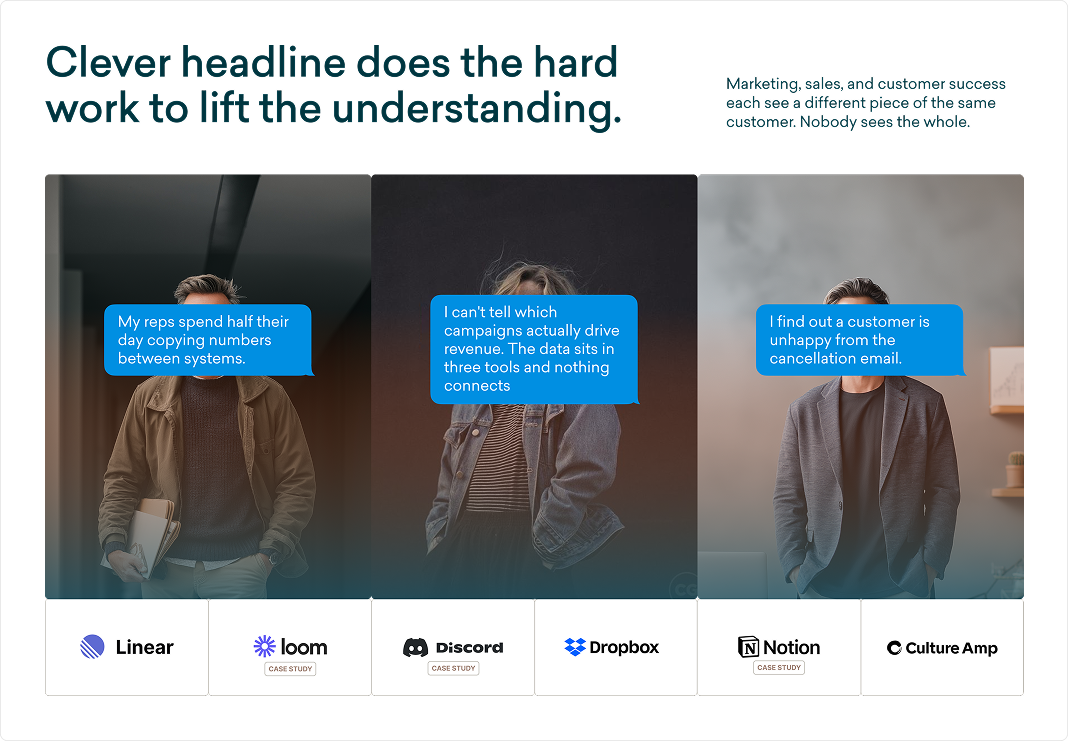
On another page, I stacked three symptoms from the same persona so a sales leader reads them and thinks "that's me, that's me, and that's definitely me":

You really need to know your buyer
This only works when you are tight in your market. If you sell the same product with the same value props to multiple segments, it breaks. Because the language isn’t tied to your solution, it’s tied to their pain. And if the buyers don’t look alike, it will completely miss the mark.
Remember my three examples from earlier. Here’s one symptom from each:
We use 4 people at the entrance to apologize for the queue and scan tickets by hand.
We never know if we’re going to hit the target before the 31st.
We have to start payroll on the 18th to make it, and there are always corrections.
Because they’re persona-specific, you cannot run these across all segments. Either you have to segment your market very tightly and understand the buyer in it, or you have to create multiple segments each with their own set of symptoms.
If your market is wide enough, I will always go for the first. One buyer persona, in one market, is the gold standard for doing marketing where you talk directly to everyone in your chosen segment. But also rare.
So how do you find these symptoms?
I decided to save my tactical 9 step process for the next newsletter. It also comes with a Claude Skill I developed that will help you create these in the right kind of language.