

Every ABM tool I looked at wanted to solve the problem I already had done: “Who should we talk to?”.
6sense, Demandbase, Terminus. They monitor thousands of accounts, track intent signals, and tell you who’s surging into market. The entire ABM industry is built around discovery. Find the accounts. Detect the signals. React.
But I didn’t need discovery. I already knew who should buy.
If you sell to a well-defined market of 500 or 1,000 accounts, the question “who should we talk to?” was answered before you ever opened a tool. You know the companies. You know the problem. You probably know the job titles.
Your bottleneck isn’t discovery. It’s activation.
And with it ABM takes a different shape.

Two motions, one label
There are two fundamentally different ways to run ABM, and the market barely ever differentiate between them when we talk about ABM.
Signal-first ABM starts wide. You load thousands of accounts into a platform or filters them from firmographics. You monitor intent signals: web visits, content downloads, keyword surges. The system tells you who’s “ready.” You react.
List-first ABM starts with business design. You built your product for a specific problem. You know who gets the most value from it, who it’s easiest to explain to, and who’s most willing to buy. So you build a list of those accounts and activate ads, outreach, content, and events against it. You create demand instead of waiting for it. When you’ve exhausted that market, you open the next ICP and repeat.
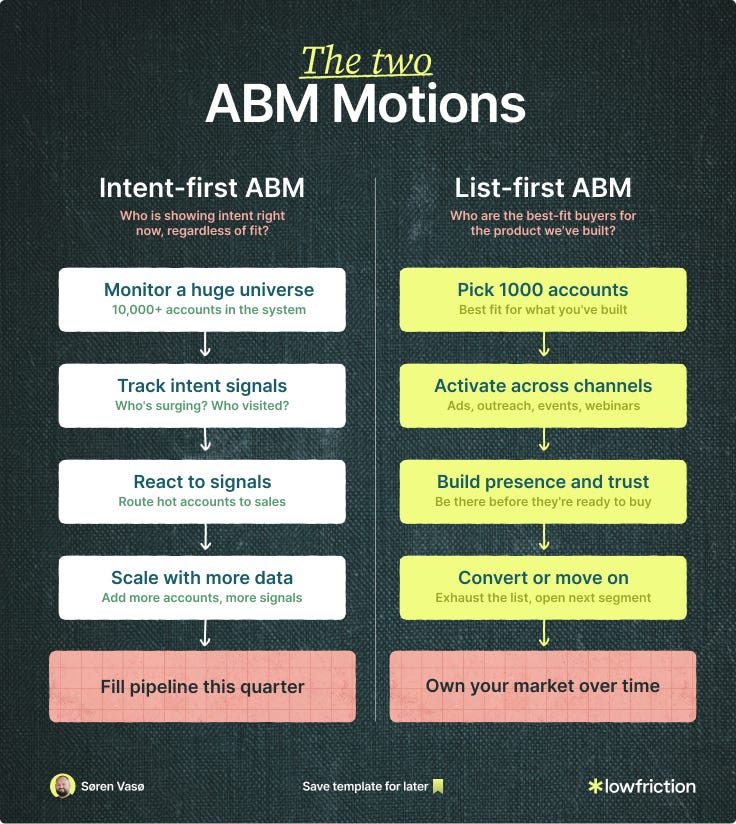
Signal-first ABM is a pipeline motion. You monitor thousands of accounts, surface whoever is showing intent, and convert them. The objective is to capture in-market demand this quarter. It has a short-term focus.
List-first ABM is a market ownership motion. You know who gets the most value from what you’ve built, who it’s easiest to explain to, and who’s most willing to buy. You build presence with those accounts so that when the pain is big enough to act on, you’re already there. The objective is to own your market over time.
They can even co-exsist and solve for different parts of your growth equation.
But when you look out into the market, most of the ABM playbooks, conference talks, and tool demos you’ve seen are signal-first. That’s not an accident. Two things drive it.
First, most companies treat ABM as a short-term leadgen tactic. We need leads now, not tomorrow. So marketing gets to work. ABM becomes a leadgen tool, not a fundational GTM model everyone works by.
Second, the tools are built for scale, not focus. ABM vendors need enterprise contracts to grow. Enterprise contracts mean monitoring 10,000+ accounts, not running focused plays on 500. So the tools were designed around breadth — more accounts, more signals, more data. The small-batch, list-first motion isn’t a product they can sell at that price point.
And as they lead the conversation and most marketers are pressured for leads, this is where we end up.
The problem with letting a system pick your accounts
Even when signal-first works, it produces a different kind of list than the one you’d build yourself. And often, a worse one.
Intent tools are great at firmographics. They’ll filter by industry, size, geography, job titles. But within that filtered universe, they can’t tell the difference between an account that desperately needs what you’ve built and one that looks identical on paper but has no use for it.
At MapsPeople, where I led GTM, we sold indoor mapping to Workplace Management SaaS companies whose products interacted with physical space. Desk booking platforms needed us. Employee survey tools didn’t. Same industry, same size, same stakeholders. The difference was a product architecture decision that lives nowhere in any database.
And even for the companies that did need indoor maps, very few was searching for “indoor mapping SDK.” The market was too small, too niche. There was little search volume to monitor. No surge to detect. The intent signal simply doesn’t exist when you’re in a market with very few players.
A tool could find Workplace Management SaaS companies. It could not distinguish who had the need and who didn’t. And it could not tell us when they were “in-market”.
So we built the list ourselves. Not because we couldn’t afford the tooling. Because we had better targeting logic than the tooling could express.
Six scenarios where intent tools are structurally blind
There are GTM situations where signal-first ABM doesn’t just underperform — it has nothing to work with. The signals don’t exist.
Category creation. You’re building something new, so no one is searching for your solution yet. You might pick up some intent signals around the problem, but that’s not in-market intent. It’s discovery. The accounts surfaced are nowhere close to a buying decision.
Competitive displacement. Your prospects aren’t “in-market.” They already have a solution. They’re not googling alternatives. You need to create switching intent by showing them what they’re missing.
Post-funding sprint. The board gave you 50 target logos. They want pipeline in 90 days. They don’t care about “surging accounts.” The target list is the strategy and everything else is execution against it.
Inbound supplement. Inbound is generating leads, but not from the accounts you actually want. List-first ABM lets you layer a focused motion on top. Going after named accounts directly instead of hoping they show up.
Ecosystem or platform selling. You’re selling into another company’s ecosystem or partner network. Your ICP isn’t defined by firmographics, it’s defined by who’s building on a specific platform or using a specific tool. No intent filter can express “companies building on Shopify who need X.
Niche markets with no search volume. Your category is so small that intent platforms don’t have enough data to model anything. They need thousands of people searching to detect a “surge.” If 15 people a month search your keyword, the system has nothing to work with.
In every one of these cases, intent data has nothing to measure. You’re not failing to use the tool correctly. The tool is measuring the wrong thing.
ABM is a GTM decision, not a tool decision
ABM works. The question is whether you’re using the right motion for your market.
If your buyers are actively researching and you need to intercept them, signal-first makes sense.
But if you already know who should buy. If your ICP fits on a spreadsheet. If your market is finite. If your buyers aren’t googling their way to a solution. Stop paying for systems that “find” accounts.
The best account list you’ll ever have isn’t the one a platform generates. It’s the one you build because you understand your market better than any algorithm can.