

“Book demo” is a very blunt instrument.
It treats all intent the same.
But intent is not binary. It lives on a spectrum.
Exploring what you actually do and how it applies to them
Thinking you might solve a specific use case
Asking for pricing because you don’t have a pricing page
Wondering if you have specific industry knowledge
Looking for your compliance info as a last check before buying
All of them could go directly to demo if that’s the only option you give. But they have very different intent and your sales team should not sherpa every leads towards buying-ready.

It’s too expensive compared to the alternative.
Having bad buyer friction by not answering questions you know buyers ask, leads to bloat in your GTM. For example, research tells us that gating pricing will add 41% more work to the sales team, without any more pipeline.
Just people asking questions, not buying.
Not letting your buyers see how the product looks, works, and operates without booking a demo is the same kind of bad friction.
Like running in a swimming pool holding a wide sheet of plywood.
You want the ease of a fidget-spinner for every stage of the intent spectrum.
So let’s manipulate some buyer friction with the “Choose your own adventure” tactic.
The “Choose your own adventure” tactic
“Choose your own adventure” lowers friction by adding more paths to get answers that are mostly self-served and removes the big expense of educating buyers with sales reps.
Here’s how a “Choose your own adventure” dropdown could look:
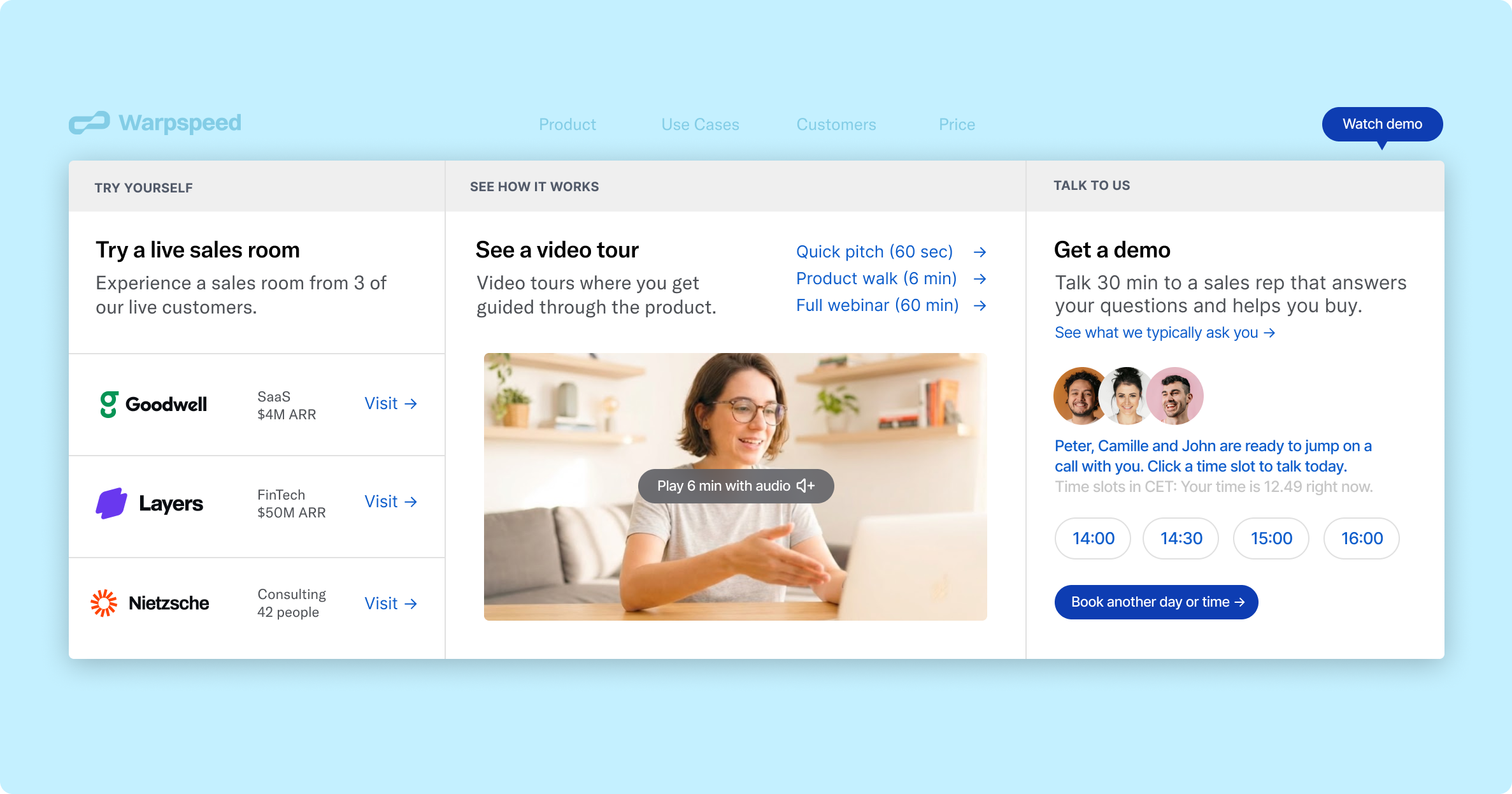
This one has 3 paths.
Try yourself — for the hands-on buyer
See how it works — for the researcher
Talk to us — for the ready-to-buy
All designed to answer specific buyer questions at different intent stages.
Let me walk you through each.
And show you all the friction-manipulating secrets baked into this design.
Start with the book demo button
Before we get to the paths, let’s talk about the button that opens the dropdown.
This can’t be called “Book demo”. That signals friction and keeps some visitors away from the button all together.
You want people to open this menu.
It’s a shortcut to valuable content that makes you look great.
When it drops down, all your added paths shows up and the buyer can pick theirs.
Instead, choose a low friction self-serving number like “Watch demo” or “See demo” or “Try yourself”.
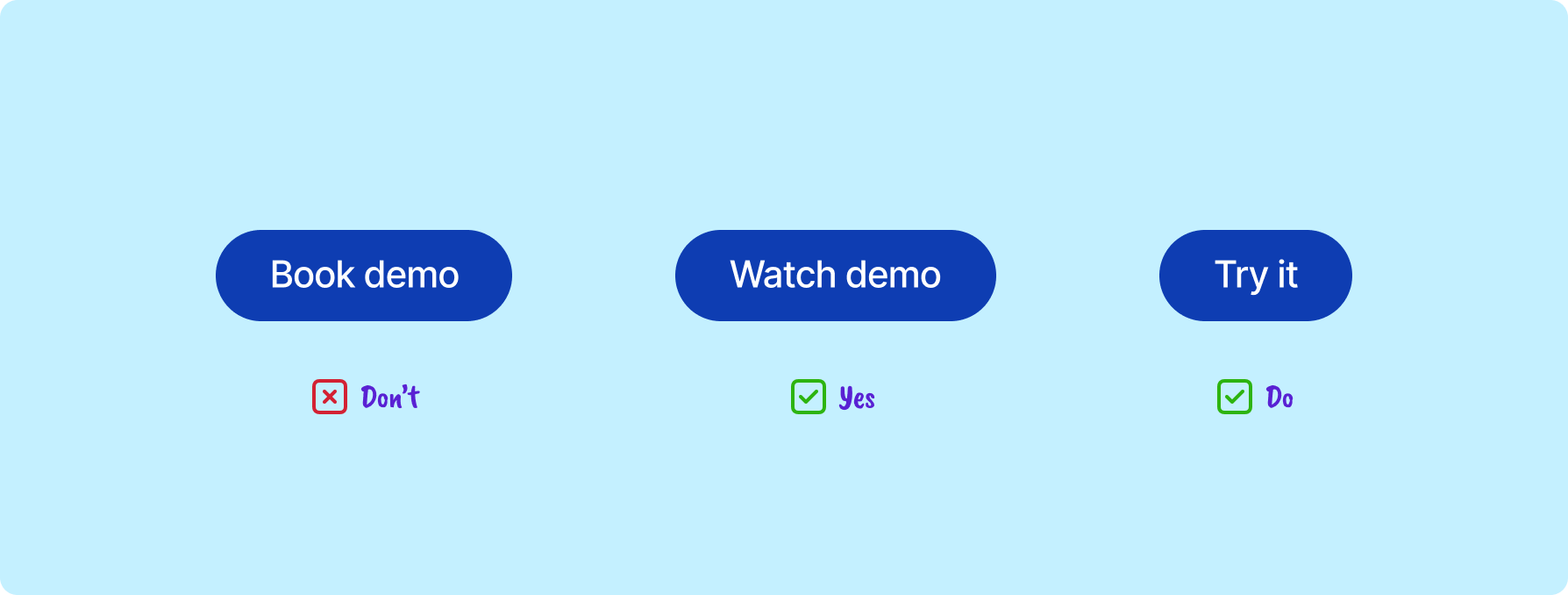
“But if it doesn’t say ‘Book demo,’ people can’t find a way to talk to us,” I hear you thinking.
You have a full website to place CTAs on and you probably already have it in your hero anyway.
And if they don’t book because your menu CTA doesn’t say “Book demo” I doubt they ever were real buyers anyway.
You are adding good friction for your own funnel here.
Now let’s get into the paths.
Path 1: Try yourself
Your product with live data. If you have a public facing product, you could use that. If it’s closed off, but you can make a public version with fake data, do that.
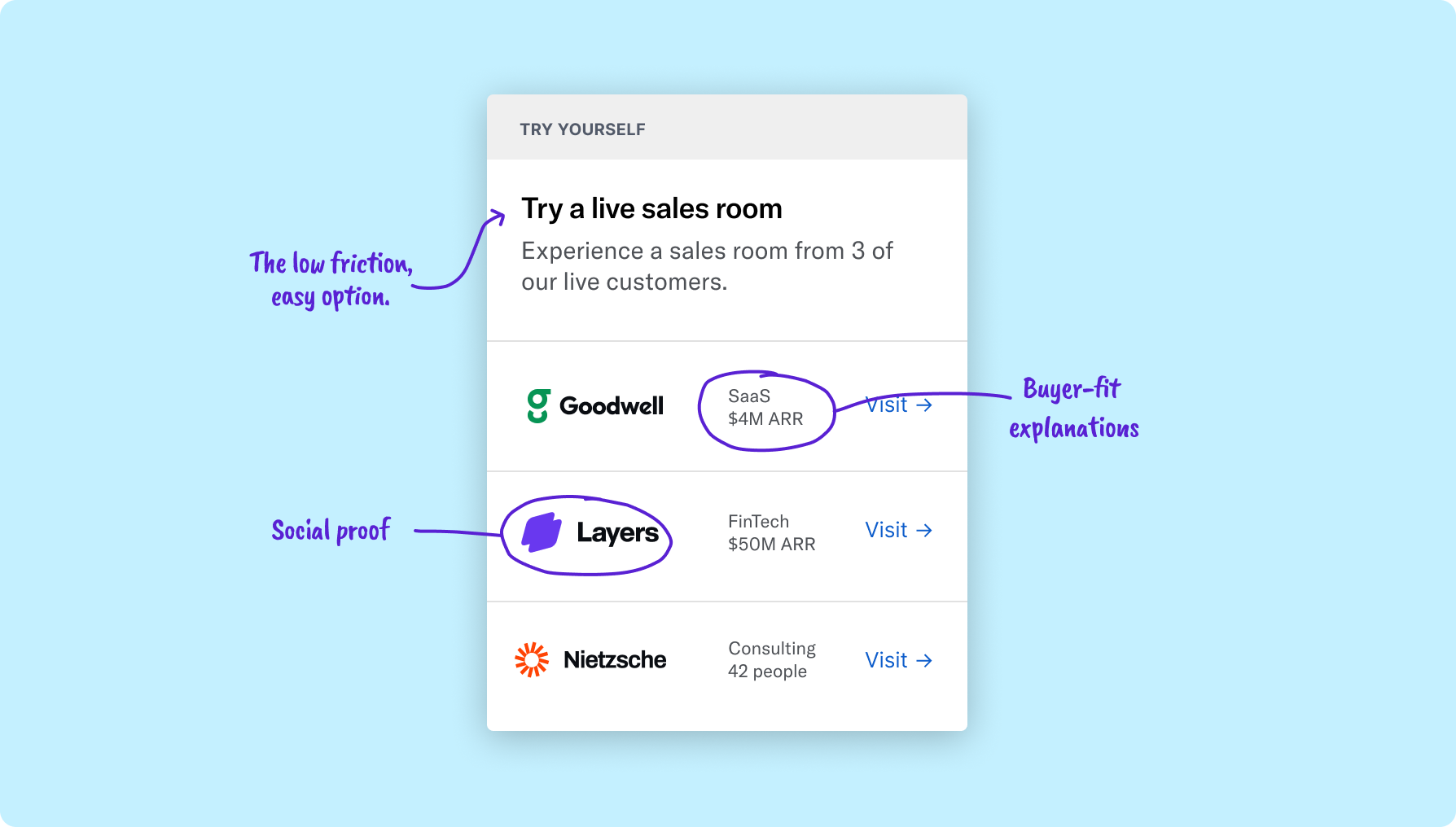
Be a little creative on how people can see your product without having to onboard through a high-friction process like empty trial or demo.
Though trials and free tiers are of course valid options, I just avoided them here to show other alternatives. For some companies the path to showing value is too hard with a trial.
It could be
Public-facing products
Sandbox with fake data
Interactive tour
Feel, see and click it
This lets the user understand your product without using your product.
Sometimes we just want to feel it.
See it.
Click it.

The goal: make the buyer behold the beauty of your UI and admire your experience. Then see how it adds business value too.
And yes, AI is eating the interface. But we’re not there yet. And until we are, your UI still matters.
Buyer-fit examples
Another great thing about this one is the buyer-fit labels. It helps identify “This is for me and my business”. And logos provide social proof that someone actually is using your product and is willing to display it.
And if you doubt this has value, you should look my newsletter on how Clay is a massive user of case studies.
Path 2: See how it works
Understanding requires story. That’s why this is the main path. I made it wider and gave it more visual weight with the video to make it feel like the most important in the dropdown.
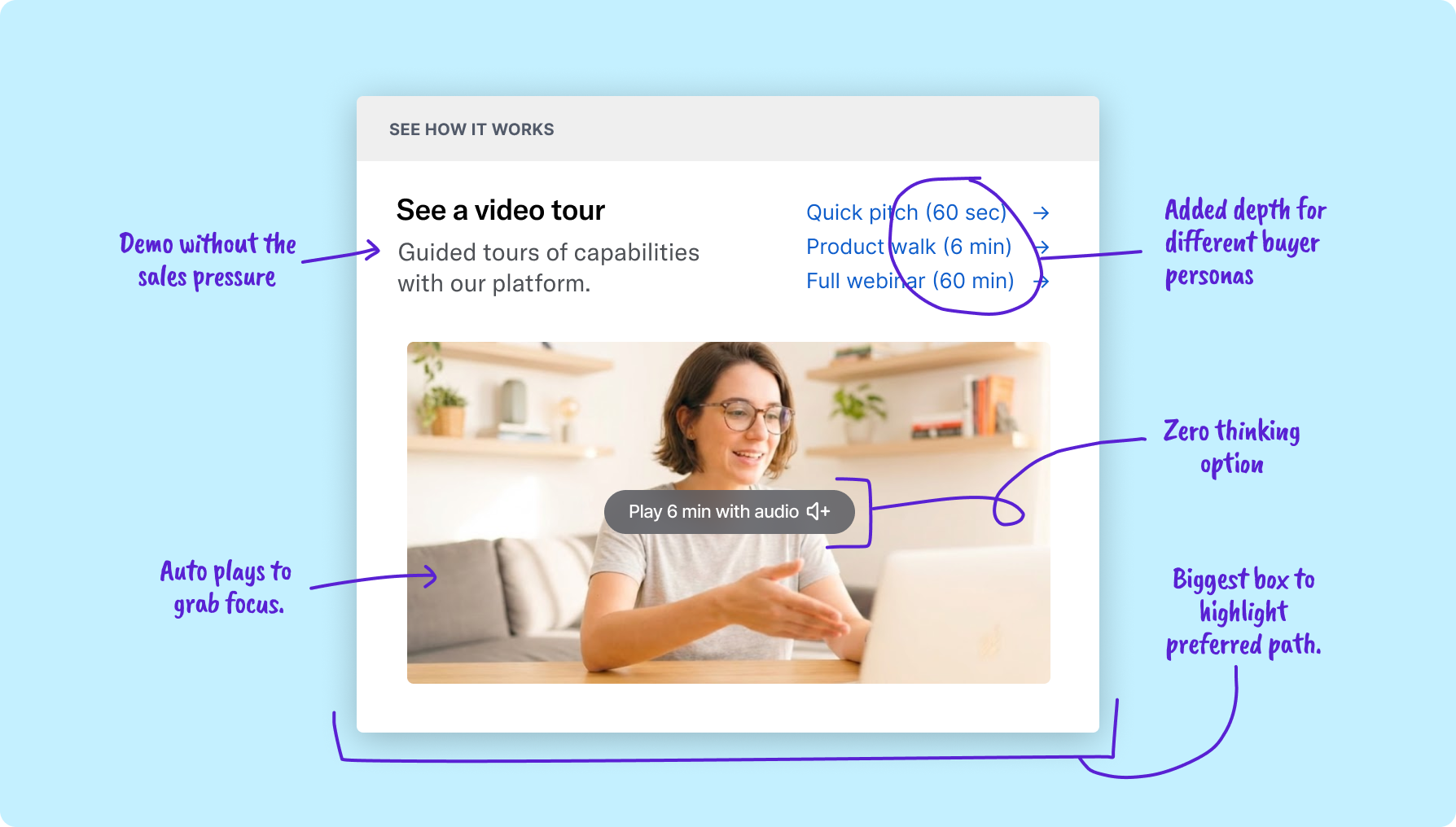
Inject value
The reason I add weight to this over the others, is because it’s what gives me the most controlled environment to explain all the good things about the product and position myself to win. Without using a sales rep to do it that is.
When the buyer choose the first path, they control everything. I don’t have any sway over putting words or images into their mind and I wanna inject value and story into their discovery.
Done right, it removes a meeting from the sales cycle that the rep doesn’t have to do.
Auto-play
I want this to autoplay without sound. Not a full video — that’s too heavy — but enough to show the good stuff they’ll experience.
This will make more people click.
Another hack I like very much: It’s already autoplaying and they’re already watching. Work the audio angle on the button: “Turn on audio.”
It feels way more smooth as an experience.
60-6-60 framework
The next behavior hack is the 60-6-60 framework.
We don’t all consume content the same way. Some want surface-level only. Others prefer to sit down on research-Wednesdays in their home office, deep-diving into materials while Marsh sets the mood in the background.
We’re different. So give people options:
60 seconds — Quick pitch
6 minutes — Product walk
60 minutes — Full webinar
It can also be 84 sec, 12 minutes and 2 hours. The point is you give people 3 varied options to learn from. This also often creates a gateway to watch one and then come back and go deeper later, because you know the option is there.
Instead of product demos you could also run with these:
Industry demos — Going over how a specific industry uses the product
Use case demos — Showing specific use cases you know win customers
Live product tour — A weekly group tour call you can jump on
Customer showcase — Getting customers to showcase how they use the product
Path 3: Talk to us
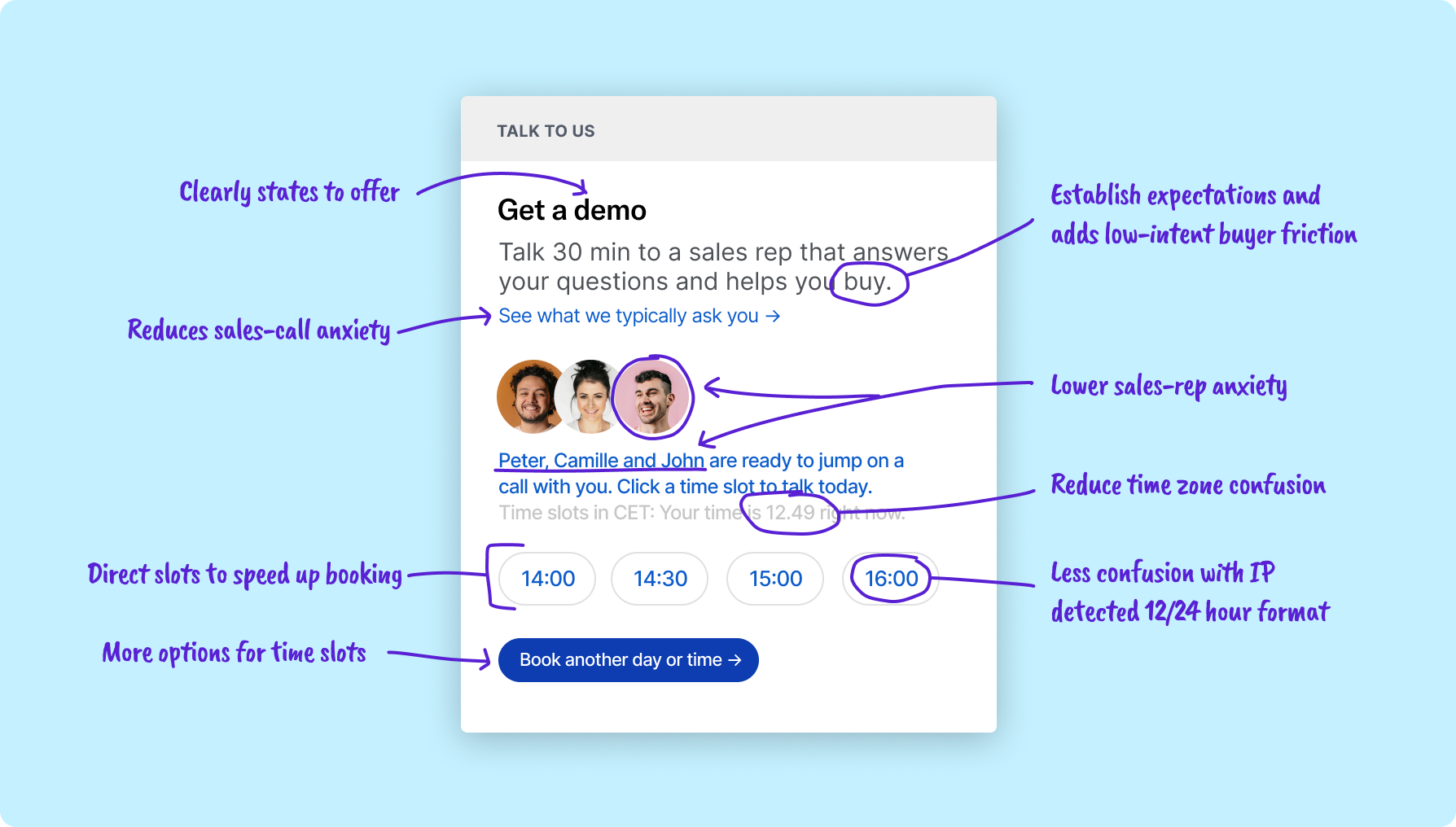
Here’s the good old “Book demo.” That was what your button did before. But I added a lot of details even in this compromised view.
Book today
Instead of a classic “book demo” button, I surface available slots so visitors can see times they can book today.
This does 2 things: It removes friction from clicking the button and it lets buyers know they already can have a demo today. That should move buyers faster into your pipeline while their intent is hot.
No idea how you do this or what tool to use, but it’s gotta be possible in the name of low friction.
I also added design to reduce friction for timezone difference and of course added a button for more dates and times that leads to your full demo or direct to calendar booking.

Add friction through expectations
I apply intentional high friction in the wording: “Help you buy”.
I want people to understand if they use this option, they end up in a sales call. If they just want to understand the product, there are other options.
You can turn up the friction even higher by saying “Book a sales call” instead of demo at the top.
Lower sales anxiety
Adding faces, names and letting people see the questions they will be asked in the call, are all things that can lower the anxiety. The more your reduce it, the easier it will be for buyers to book that meeting.
Capture intent signals from each path
Each of these paths is an intent signal. A 1st party intent signal nonetheless.
With simple click-tracking for each path, you can see what adventures people are choosing. Measure for a month and understand your buyers way better.
If you have an even more advanced setup where you track on individual level or account level, this is all signal you wanna catch.
Each path = intent signal.
Try = curious
Watch 60s = browsing
Watch 6min = evaluating
Watch 60min = serious
Book = buy-ready
Imagine seeing someone try your product one week. Then come back to watch a 6-minute video. Then the 60-minute tour. Then book a demo.
Those signals tells you so much about intent level.
Or: you just finished a sales call, and someone else from the same account is watching the 60-minute tour. Every sales team wants that information before jumping on a call.
It helps you identify the right accounts and intent level.
Yes, you’ll still see someone walk straight to “Book demo” thinking you sell solar panels for electric scooters as a software company. Humans will be humans 🤷♂️
But you can eliminate a lot of noise by understanding and placing strategic friction in your funnel.
In fact, by implementing this tactic, you have answered all of these buyer questions that are present in all journeys:
How do you solve the problem?
What makes you different from competitors?
What does the product do (in plain terms)?
What are the capabilities?
Can I see how the product looks and feels?
Can I see how the product works?
How easily can I try the product myself?
What questions will you ask us on the demo?
What will we learn from a demo?
A demo-page answers 0 of them.
Knowing if it works
The ultimate test: how buyer-ready are your new demo bookings?
And is there a drop in bookings?
If there is a drop, it’s not bad. Most likely it means you are reducing noise in the pipeline and keeping low-intent buyers from spending your sales team’s time.
Future reports will confirm.
Start by measuring pipeline progression. How fast do prospects move through the pipeline and where do they drop off?
And then you ultimately want to measure on closed lost/won.
Remember to do a benchmark before you implement, so you have something to compare with.
Caring if it works?
Let’s say you can’t prove this by the numbers. Ask yourself: is this the buying experience I would like?
If you are like the rest of the market, it is.
Buyers are ~70% through their decision before they reach out.
61% of B2B buyers prefer a rep-free sales experience.
Your sales process is as little as 3,4% of the full buying journey.
Every damn study on B2B buyer behavior keeps confirming that buying is bigger than selling.
The question isn’t whether buyers want more ways to learn before talking to sales.
It’s proven again and again.
The question is whether you’ll meet them where they are.
Or keep funneling everyone through a door most of them don’t want to open.
Give them paths.
Watch which ones they take.
Then sell to the ones who are ready.
That’s how you turn a blunt instrument into a low friction revenue machine.
Want to know more about how buyers actually buy?