

Almost all SaaS companies have one huge flaw in their messaging.
Every time I get to work with a new client, I bring this up and it turns into a messaging lesson.
Because most don’t know the difference between features, capabilities and outcomes.
Or more precisely: they don’t know what capabilities really mean.
So here’s the lesson.

The two extremes that kill your messaging
Extreme 1: Feature-led messaging.
“We have real-time dashboards, SSO, API integrations, and custom workflows.”
Cool. What do I do with that? The buyer has to translate your feature list into their own problem. Most won’t bother. They’ll bounce.
Extreme 2: Outcome-led messaging.
“Grow revenue. Reduce churn. Transform your business.”
So does every other vendor on my shortlist. When everyone promises the same result, nobody stands out. Research shows 40 to 60% of B2B deals end in no decision. Not because a competitor won. Because the buyer couldn’t confidently choose.
Both extremes create the same result: the buyer doesn’t see themselves in your product.
The missing layer: capabilities
There’s a level between features and outcomes that most SaaS companies skip entirely.
A feature is what your product has.
A capability is what your buyer does with it.
An outcome is what happens in their business because of it.
Features are ingredients. Capabilities are the meal. Outcomes are not being hungry.
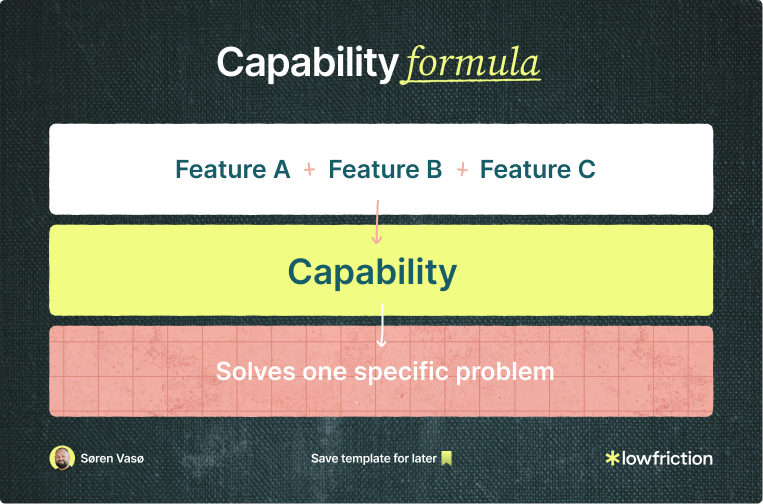
A single feature rarely solves a problem on its own. Often it’s multiple features that unlock one or more capabilities. And those we can map directly to a problem worth solving.
Case: Evercam
Here is a problem you never thought of.
You have a construction site and cameras monitoring it 24/7. You have lots of moving parts and sometimes incidents occur. You need to be able to pinpoint fault, security, compliance with rules and make sure it never happens again. So you wanna catch all incidents. But sometimes you don’t know exactly when what happened. So you have to go through lots of video material.
Evercam does construction site visibility and can solve that problem for you:
Features
Camera hardware
Object detection
Event timestamp
Capability — Incident capture and investigation. When a car crashes into the construction site, you have all the evidence you need without having to look for it.
Outcome — Fewer legal fees, fewer manual hours, better security = you save money
Messaging for Evercam with and without the capability:
Features + Outcome:
With Evercam, all cameras have object detection and event timestamps so you don’t have to spend hours on manual reviewing video and fighting legal cases without evidence.
Capability + features + outcome:
With Evercam, you get Incident Capture and Investigation. It automatically detects objects and timestamps events, so you don’t have to spend hours on manual reviewing video and fighting legal cases without evidence.
The first leaves out the capability, and even if you can do the math in the head because you know the problem, it requires more of you.
The second makes it clear what your new capability will be if you get Evercam. It feels more solid and easier to buy. It’s something that’s already built for you and you just use it. Not separate features you need to manipulate for your use case.
But a lot of times, people are trying to solve one specific problem when looking at your software, so they don’t have the context of the pain. Maybe the buyer is looking for Evercam because they need to do remote site management and supervision. So their pain is using time driving around to all building sites and spending lots of human hours on that. Object detection and timestamps means nothing to them. But they know that the team also spends lots of time on incident management, so that might be another value the software could add.
Capabilities add clarity to what problems you solve.
And if you wanna visualise the formula, it looks like this:
Capabilities remove buyer friction
If you’ve been reading this newsletter, you know I see everything through the lens of buyer friction. This one is no different.
Feature messaging creates cognitive friction. The buyer has to figure out what your tech specs mean for them. That’s work you’re making them do.
Outcome messaging creates trust friction. Big promises without a visible mechanism feel like marketing fluff. When your homepage says “grow revenue 40%” and buyers can’t see how, they don’t believe you.
Capability messaging removes both.
It shows the buyer the action they’ll take. That’s the thing they can evaluate. The thing they can picture doing on a Tuesday morning. And most importantly, it’s the thing your champion repeats in the room when you’re not there.
Nobody walks into a buying committee meeting and says “it has real-time dashboards.” Nobody says “it’ll grow our revenue.” What they say is: “We can finally see which accounts are heating up and act on them before they go cold.”
That’s a capability. And it transfers belief. The buyer goes from “sounds nice” to “I can see how that would work for us.”
How do you find your capabilities?
Firstly, you need to understand the problems you are trying to solve. People buy because they have something they want to solve differently. When you have that, your capability is the language of what your buyer now can do to solve that problem.
Here is your worksheet.
Problem: “We are drowning in manual hours searching through video for incidents”
Capability: “Incident Capture and Investigation: Get automatic object detection with timestamps from all of your cameras”
Features: Object Detection, Timestamps, Incident Log, Auto-clip of video.
Outcome: Company X saves 16 hours monthly per construction site they used to use rewinding video and caught 40% more incidents in year 1.
This lets anyone follow the story step by step and makes your value crystal clear.
Now, I’m not saying this is a small task. It requires you to understand who you are talking to, what their daily jobs are, what problems they face and interpret how you solve for them. This is product marketing work at its finest. But between product discovery, building the product and talking to customers, you have the information. Now it’s about channelling it forward so you get the reward of telling the market you solved a problem for them.
Capabilities is not about removing features or outcomes.
Features are great for checklist marketing. Buyers need to know if you can do this specific thing or integrate into their stack.
Outcomes are great for high-level understanding. Buyers want to see your claims and how you could move their needle.
But capabilities is where you translate into how they will use your product on a Tuesday morning.
If your buyer can’t picture themselves using your product before they talk to sales, you have a capability language problem.
And that problem is costing you deals you’ll never know about.