

I like industry pages. A page where all your value props, features and case studies are packaged into the context of the buyer.
Buyers also like them. 91% of B2B buyers say content like this is “very important” in the research phase and 82% they even expect it from vendors.
Companies see an effect from them. Tailoring copy, proof, and CTAs industry, use case and lifecycle stage raises the likelihood to convert.
Yet we don’t prioritize making them.
Industry pages have my attention this week because of two things:
I’m making 3 for one of my customers to lower buyer friction and get the attention of the right kind of leads they are in the market for.
Casey Hill sent me down a rabbit hole with this LinkedIn post. Data from 8 SaaS companies shows industry pages are not the most valuable kind of context page if you look by the clicks. It’s role/team/department context pages.
That made me wonder: Am I doing this right? I’ll share my thought process and outline some examples with you here in this newsletter.

What is the objective of a context page?
I’m using the word context page as there are multiple kinds of ways to put context before the buyer. Industry pages are just one of them. I’ll list more types later. Back to the objective:
The core objective is to build trust by showing buyers how your product fits their world.
Aka, lower the friction in the buying journey to let the buyer slide into your pipeline.
A generic home page without context forces the buyer to do a translation: “Okay, they do X… but how does that apply to my situation?” A context page works as the translator and helps the customer see how you already know their world and how the product fits into it.
You can break this down into a few sub-objectives:
Signal relevance. A buyer wants to know: “Is this for me?” A context page answers that in seconds through language, images, and proof points that mirror the world of the buyer.
Reframe value props to the buyer’s language. Your product is more than likely to do the same for all buyers. But certain words and jobs to be done mean more in one context than they do in others. So context pages give you an opportunity to focus on what matters to each buyer’s context and suppress other things you would otherwise highlight on your other website pages.
Lower perceived risk with relevant proof. A case study from a similar company in a similar industry at a similar size is 10x more persuasive than a generic testimonial. Context pages let you cluster your strongest social proof where it matters most.
Qualify and route the right buyers. Context pages act as a self-qualification mechanism. They attract the buyers you actually want and help the wrong-fit visitors self-disqualify early, which saves your sales team time and makes it easier to sell when buyers look the same.
Match search intent. When someone is asking ChatGPT: “Which CRM is built for real estate?” you have much higher chances of being cited by answer engines if you have a good context page for Real Estate.
What kind of context pages are most valuable, then?
From the very small batch of numbers Casey provided in his LinkedIn post, we have two data points:
Best performing: Role/Team/Department pages.
Worst performing: Industry pages.
That made me wonder: What kind of context pages could we actually make?
Here’s the list I have right now:
By Industry: SaaS, Manufacturing, Wrestling promoters
By Title: CMO, CEO, Dog Walker
By Buying Role: Champion, Economic Buyer, Technical Evaluator
By Department: Marketing, Sales, Product
By Team: Commercial, Backend, Development
By stage: Start-up, Scale-up, Enterprise
By size: SMB, Mid-market, Enterprise
By Pain Point/Problem: data silos, manual processes, compliance risk
By Technology: CRM, Marketing Automation, Workforce Management
By Frameworks: GDPR, HIPAA, SOC2, ISO
By outcome: Reduce churn, increase conversion, shorten sales cycle
By deployment model: B2B, B2C, Marketplace, Platform
By maturity level: Beginner, Experienced, Expert
By migration: From WordPress to Webflow, from Framer to Webflow, from HTML to Webflow.
This can seem overwhelming. How on earth do we know what kind of context pages are right for us? To help you find an answer, I’ll share a story of why we chose to do framework pages at Wired Relations when I worked there as Head of Growth.
How I used context pages as primary entry point
Wired Relations is a compliance software company. They help compliance departments with GDPR and information security.
We divided our market into two segments.
Segment 1: Those who didn’t care about compliance but were forced to get the check mark to show customers and government institutions.
Segment 2: Those who thought of compliance as a competitive advantage and had dedicated people running it as a department.
This market segmentation is important to understand, because it helped decide what kind of context pages we would run with.
If we marketed to segment 1, I would have chosen to run industry pages. The buyers here were looking for someone who had done this before for companies who looked like them.
That was not our market.
We marketed to segment 2: the experts.
Their entry into buying new compliance software was not because they didn’t have any today. They wanted software to work more effectively for them. We had to convince them to replace software, not just buy it.
That’s why we chose frameworks. That was where the buying moment opened.
A compliance specialist looks at something new the market is demanding they comply with, like the NIS 2 framework or ISO 27001. Both are frameworks where you must go through a specific process to get the mark of compliant and keep it.
But not having done this before, they looked beyond their current system, which could not do this, or at least they had doubts about how, or if, it was the most efficient way of doing it.
So our context pages created that buying moment and explained all our value props and features from that context point. Not “How to use Wired Relations”, but “How to work with NIS 2 with Wired Relations”.
The page looked like this:
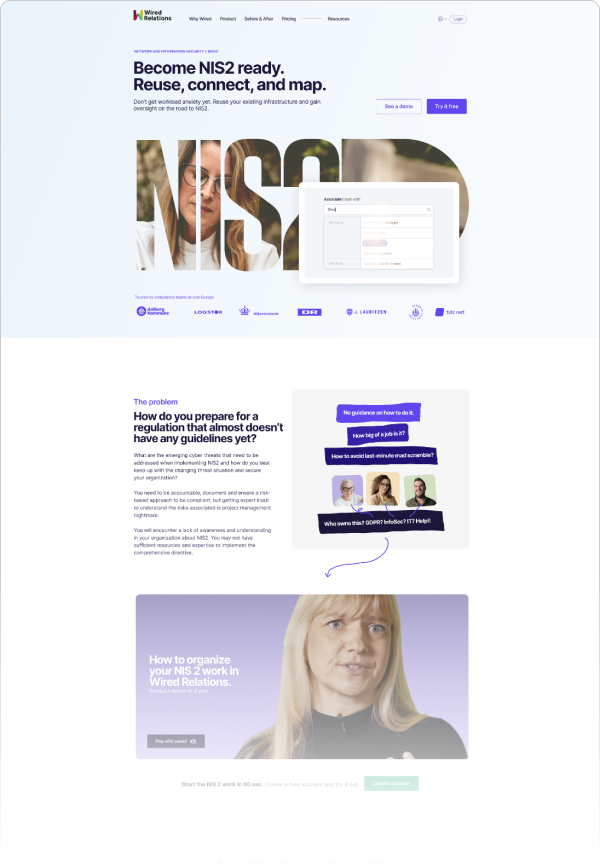
This page is too long and too big to include in this newsletter, but you can study it by following this link or click the button.
We built 9 of these, and it was our biggest entry point for generating demos and free trials. Both from new buyers and the ones who already knew us.
So which should you choose then?
This is definitely something you should test. But as most companies don’t even make an industry page, testing multiple variants seems like a hard-won path to take. So I’ll try to answer it confidently anyway, so you can start producing.
Look at your ideal customer profile. How do they understand your product best in their context?
Does the product have a super user and very few other users? Go with pain/framework/role
Is it a department or team primarily that works in it? Go with department/team
Is the product used by everyone in the company? Go with industry/size/stage
Is the product infrastructure that serves the company? Go with industry/size
Do none of the buyers operate under the same business model? Go with deployment model
But honestly, I have no idea which would work best for you. It is very context-dependent (no pun intended). I would need to know the customers, market and product before being able to answer.
But that is why I love marketing.
If you are willing to spend time understanding your customers and are business savvy, there are very few problems you can’t impact.
Start building context now
Should you still build industry pages then?
Industry pages, it depends. Context pages, definitely.
Buyers like them.
They impact business.
It’s an underused tactic.
If you start now, you’ll have a lot of upside on this tactic.