

“You look hungry. Come get free dessert. Look at the menu. We have steaks. How about just a coffee? I’m holding the best view for you! Tomorrow then?”
You were just walking. On vacation. Hard-earned. And then someone almost jumped you to get you into their 200-item restaurant at 3pm in the afternoon.
You know why? Because you sent a signal. You walked by not looking like a local, so you gotta be their ideal customer right?

Fast forward 7 days. You’re back from vacation, but you meet the same behavior. Now it’s just a PM on LinkedIn.
“Hi — I saw you are hiring GTM engineers. I thought it was a great chance for me to introduce you to our CRM tool with a native MCP!”
And you’re like: “Are we hiring GTM engineers?”
Welcome to signal-based selling at scale.
Same mechanism as the tourist trap. We just scaled it with technology.
The tourist trap looks for foreigners he can lure into spending a few bucks. He doesn’t try to go after the locals. It’s a waste of time. He is selecting who to pitch from one thing: do they look like tourists?
Running signal-based is mirroring that behavior. Looking for who is in-market by judging 3rd party signals like funding rounds, job postings, hires and web searches.
But me walking down the street is not the same as I’m hungry and looking for a place to eat. Nor does me looking for a new employee mean I wanna buy your CRM on a cold outreach.
So is signal-based any good then?
Yes. When applied the right way at the right company. That’s where most of the problem starts.
Let’s stereotype it. Two kinds of companies. Two ways of running it. Only one of the four squares should actually be doing this.
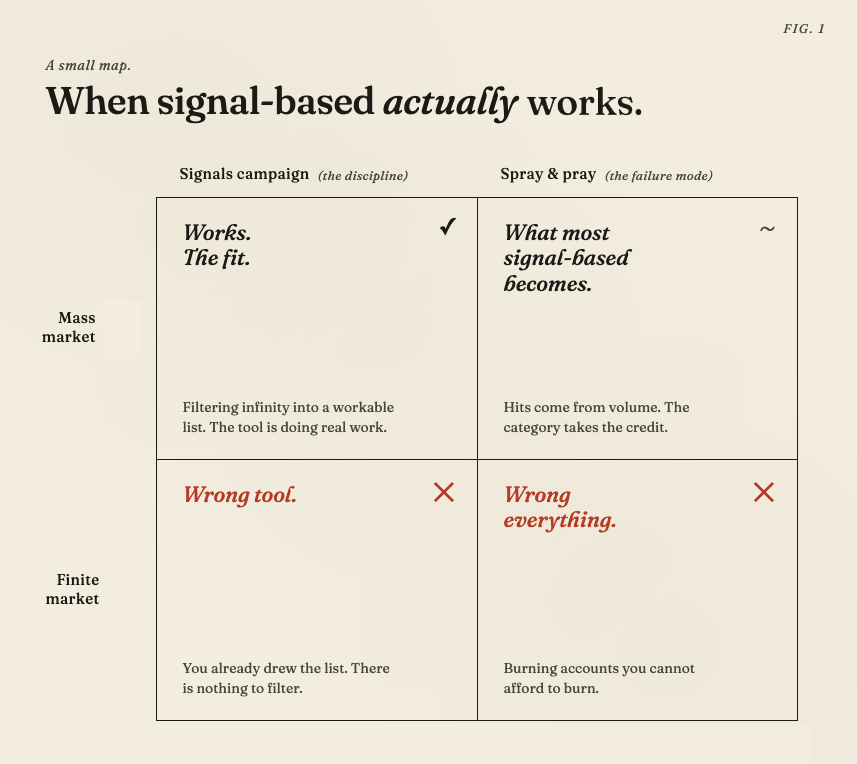
The signals campaign is the right way to do it. You filter accounts by firmographic and signal. You build a real campaign to go connect with them and work through that list. It’s craft. It’s slow. It works. When you are in mass-market, you probably have enough leads to burn and it’s more important to find the ones that are actively looking to solve a problem, than the ones not in market to solve a problem. And then you have a broad set of use cases you can apply to the signals you find.
Spray and pray is what most companies actually do. An SDR pulls a list of anyone in the vicinity and starts sending a generic outreach message hardly tailored to the signal and wants 15 minutes of your time. Some hit. But in reality, the hits come more from volume than the signal.
If you’re a mass-market company, top-left is your home. Run the discipline. Skip the spraying.
But finite-market companies have to think differently about signal-based.
I think of a finite-market company as having few use cases and clear boundaries of who would be great customers. So they could build a list of 1000 companies and say, these are our ideal customers to go get.
In that space, you don’t have a which buyers problem. You have a how do we work our ideal buyers problem. Different game. Different motion. It becomes about activation of your list, not surfacing more accounts to do mass communication to.
In a finite-market you can’t burn leads the same way as in a mass-market. You have a finite number of them, so you have to lean on quality in your approach. Now 3rd party low quality signals are not as good looking anymore.
That doesn’t mean you don’t get FOMO and want signal-based like all the cool start-ups. But it’s worth knowing that running signal-based from the wrong GTM position will only fill the pipeline with the wrong leads, burn the right accounts, inflate CAC and slow growth. It will look like you have a sales execution problem. But it’s actually a strategy problem of not understanding your position and picking the wrong tools.
If you know your ideal 1000 buyers, you don’t need a tool that finds leads. You need a way to actually work the ones you’ve already picked.
Signal-based tools are not built for that job.
They’re built to flag down strangers on the street.