

Go-To-Market is a hot topic on LinkedIn these days.
GTM engineer, GTM tools, GTM orchestration.
And every time I read some of it, I get frustrated. It’s reduced to a shallow version of what GTM strategy actually is.
There are 2 patterns I keep seeing where GTM is watered down. I’ll show you both, then give you the full picture most posts are missing with my GTM Cheat sheet.

1. Clay/Claude Code + AI + Outbound = Go-To-Market
Most “GTM Engineer” content on LinkedIn is a cover story for sending more cold outbound. Just faster with AI and Clay or Claude Code. Clay popularised the GTM Engineer role and I actually love the concept.
What once was hard is now easier than using a Canva template. But when 90% of the content is “here’s how I send 10,000 personalized emails a week with AI”. That’s not go-to-market strategy. That’s one tactic inside one channel.
2. Tech stack = Go-To-Market
The other is the tech stack. Clay, Claude Code, Attio and Slack nicely stacked in a graphic, keeps occupying my feed with GTM as the premise. Some take it further and draw up their workflow diagram between the tools, but the outcome is the same. It’s not GTM strategy. You need tools, but it’s the same as showing someone you kitchen and calling it a recipe. The tools serve the GTM strategy, they are not the strategy.
Where did the rest of GTM go?
Both patterns draw from the same source. The GTM Motion: How you connect with the market.
And the motion matters.
Without it, nothing happens.
But what’s missing is the GTM Platform: How you plan to attack the market.
The motion is how you reach people. The platform is why they should care when you do.
That’s the part that puts strategy in Go-To-Market strategy. I’ve spent years consulting 50+ SaaS companies and running GTM from the CMO chair in two others.
Here’s the framework I use to make sure both sides are covered.
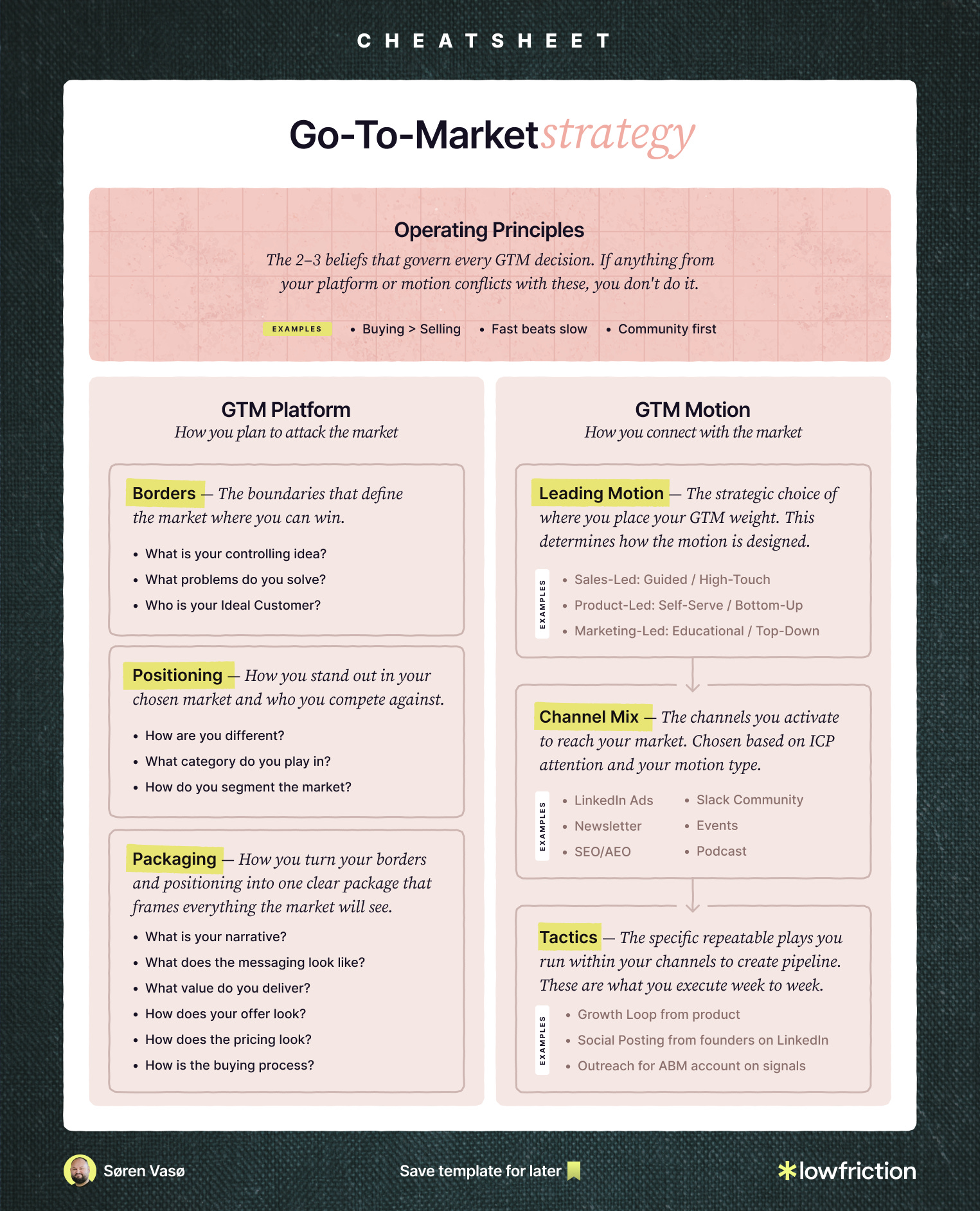
The GTM Platform in 89 words
The Platform has three stacks that work together.
Borders define the market you can win. Your core belief, the problems you solve, and who you serve.
Positioning is how you stand out within those borders. Your category, differentiation, and segmentation.
Packaging is how the market experiences all of it. Narrative, messaging, value props, pricing, and buying process.
All of this should be in place before you pick a single channel or run a single tactic The bigger the team, the more this matters. Every gap in the platform becomes internal friction later.
Let me show you what I mean with two examples.
Two examples of how the platform drives the motion
Example 1: The AI-Agent CRM
Borders — You decide to solve the problem of keeping track of customer data and acting upon it. Your controlling idea: doing it 100% with AI agents. Not “AI-assisted.” Not “AI-powered.” The agents ARE the CRM.
That controlling idea forces your ICP. If you say “100% AI agents,” you can’t sell to enterprises with 200 AEs and a Salesforce admin team. You need buyers without sunk cost in the old way. Tech companies with 10-50 employees fit. They adopt fast, have less legacy CRM baggage, and their sales teams are small enough that an AI-first approach doesn’t threaten an army of existing users.
Positioning — You are going to lose if you compete with Salesforce and their AI solutions. So you have to split the CRM category and talk about it differently, putting all the weight on “no human data entry” messaging. Legacy CRM can’t follow you into that messaging.
Every other CRM makes humans do the work and calls AI a feature. You flip it. The AI does the work. Humans review. Segment by team maturity with AI tools. Target teams already using AI in other workflows. They won’t need convincing that AI can do real work.
Packaging — Narrative: “Your CRM should work for you, not the other way around.” Lead with the pain everyone knows. Every sales team hates logging. Start there.
Offer: Free tier with limited AI agent actions. Paid = unlimited actions + custom agent workflows. Pricing: low seat cost + usage-based credits. Low risk to try, and revenue scales with value delivered, not headcount.
Buying process: self-serve signup, connect your email and calendar, watch agents populate your deals and accounts.
Now watch what happens to the motion.
Product-Led Growth is the obvious choice. But the platform decisions above constrain HOW you run PLG:
You need credits to let people experience value. That’s upfront cost per free user. You need funding or very efficient acquisition.
Self-serve buying means your website, onboarding, and in-product experience carry ALL the weight. No AE to save a bad first impression.
Usage-based pricing means expansion revenue is automatic IF the product delivers. Your growth loop becomes: try, see value, use more, pay more, tell others.
This connects directly to business strategy. If you’re bootstrapped, you cap free credits tightly and focus on a narrower ICP (say, only agencies) where conversion rates are higher. If you’ve raised, you afford more generous free tiers to grab market share. The platform and motion feed back into how you fund the company.
Example 2: Operations for AirBnB Hosts
Borders — You’re solving the problem of running financials and operations for AirBnB hosts managing 20+ properties. Spreadsheets, multiple tools, no single source of truth.
Your controlling idea: “The AirBnB host life without the hassle.” You’re not building accounting software. You’re building a lifestyle enabler for professional hosts.
Why 20+ properties as the floor? Below that, spreadsheets still work. Above 100, they likely have staff and custom solutions. The 20-100 range is where the pain is sharpest and the willingness to pay is real.
Notice: the controlling idea is a lifestyle promise, not a feature promise. You’re not competing on “better reports.” You’re competing on “get your weekends back.” That shapes everything downstream.
Positioning — Category: Instead of going into the classic accounting software or property management categories, you wanna go very laser focused “Operations platform for professional AirBnB hosts.” You’re specific to AirBnB hosts because their problems are unique: dynamic pricing, guest communication, cleaning schedules, seasonal demand.
Generic property management tools serve landlords, real estate agents, and hotels. They’re broad. You’re laser-focused on the AirBnB workflow. Every feature maps to a host’s actual day.
Segment by geography first. AirBnB hosting density varies wildly. Start where the biggest pool of 20+ property hosts exists. Pick ONE region to win first.
Geography matters here in a way it didn’t for the CRM. AirBnB hosting is tied to local regulations, tax rules, and seasonal patterns. If you try to serve all markets at once, your messaging fragments and your resources spread too thin
Packaging — Narrative: “You became a host for freedom, not for spreadsheets”. Messaging: lead with time saved and money found. “Hosts save 12 hours a week and find an average of $X in missed deductions.”
Offer: all-in-one. Financials, cleaning scheduling, dynamic pricing insights, tax prep. Bundled, not modular. Because the value prop is “no hassle.” If you sell modules, you’re creating the very complexity you promised to eliminate.
Pricing: flat fee per property, per month. Not per seat. The host IS the user. Pricing per property aligns cost with the scale of their business. Dead simple to understand.
Buying process: This audience is NOT tech-savvy in the SaaS sense. They don’t want to “configure” anything. Onboarding has to feel like “connect your AirBnB account, we handle the rest.”
Now watch what happens to the motion. It’s completely different.
PLG is NOT the obvious choice here. Why?
The ICP doesn’t hang out on Product Hunt or Twitter/X. They’re in Facebook groups, AirBnB host forums, local meetups, and YouTube channels about hosting.
The product requires connecting real financial data. That’s a trust barrier to just connect to see how it works. They want to talk to someone first.
The deal size (20+ properties times a monthly fee) is meaningful enough to justify a sales-assisted motion.
The right motion is community-led + sales-assisted:
Community-led acquisition. Be present in every AirBnB host community. Not with ads. With genuinely useful content: tax tips, pricing strategies, operational templates. Build trust first. Sponsor podcasts and YouTube channels the pro AirBnB hosts listen to.
Sales-assisted conversion. Once someone is interested, a short guided setup call. Not a hard sell. A “let us connect your account and show you what we find.” The AHA moment IS the onboarding.
Referral-driven expansion. Hosts know hosts. A referral program with real incentives (free month per referral) is your growth engine. This audience talks to each other constantly.
This feeds back to business strategy too. Community-led + sales-assisted is slower to scale but more capital-efficient. You don’t need to burn cash on free credits. You can bootstrap this if your market entry is tight enough. But it also means you need patience and a content engine, not a growth-hack playbook.
That’s why you can’t copy playbooks of LinkedIn
The platform doesn’t just “inform” the motion. It constrains it. The CRM’s tech-savvy ICP and low-risk free tier enabled PLG. The AirBnB host’s non-tech ICP, trust barrier around financial data, and community-driven behavior demanded a completely different approach.
If you pick the wrong motion for your platform, the unit economics break, the buying experience feels off, or you’re reaching the wrong people in the wrong way.
So when you hear someone say “Steal my GTM strategy” and it’s how to do outbound with Clay + AI, understand: It’s one tactic, inside one channel, inside one motion. Not a GTM strategy.
With that said, there are tons of cool tactics and plays I read about every day on LinkedIn and save for my own swipefile. But I always crossmatch with my platform before deciding if this is actually something I could deploy.
Their platform isn’t your platform. Their motion was built on decisions you didn’t make. Take inspiration from it. But don’t copy it.
Being able to see that difference is what separates a manager/director from a VP/CMO. You gotta understand the strategic layer to lead GTM, not just run it.
I’m recording a full video walkthrough of every moving part in this framework.