

The other day, I asked Gemini:
“Can my team use Claude and ChatGPT through Notion AI without losing features? I love the idea of having AI where our context lives. Research and writing capabilities are most important (and we have Gemini on the side as stand-alone AI)”
And I got my answers in 15 seconds with a nice table of feature comparison, limitations and even a recommendation.
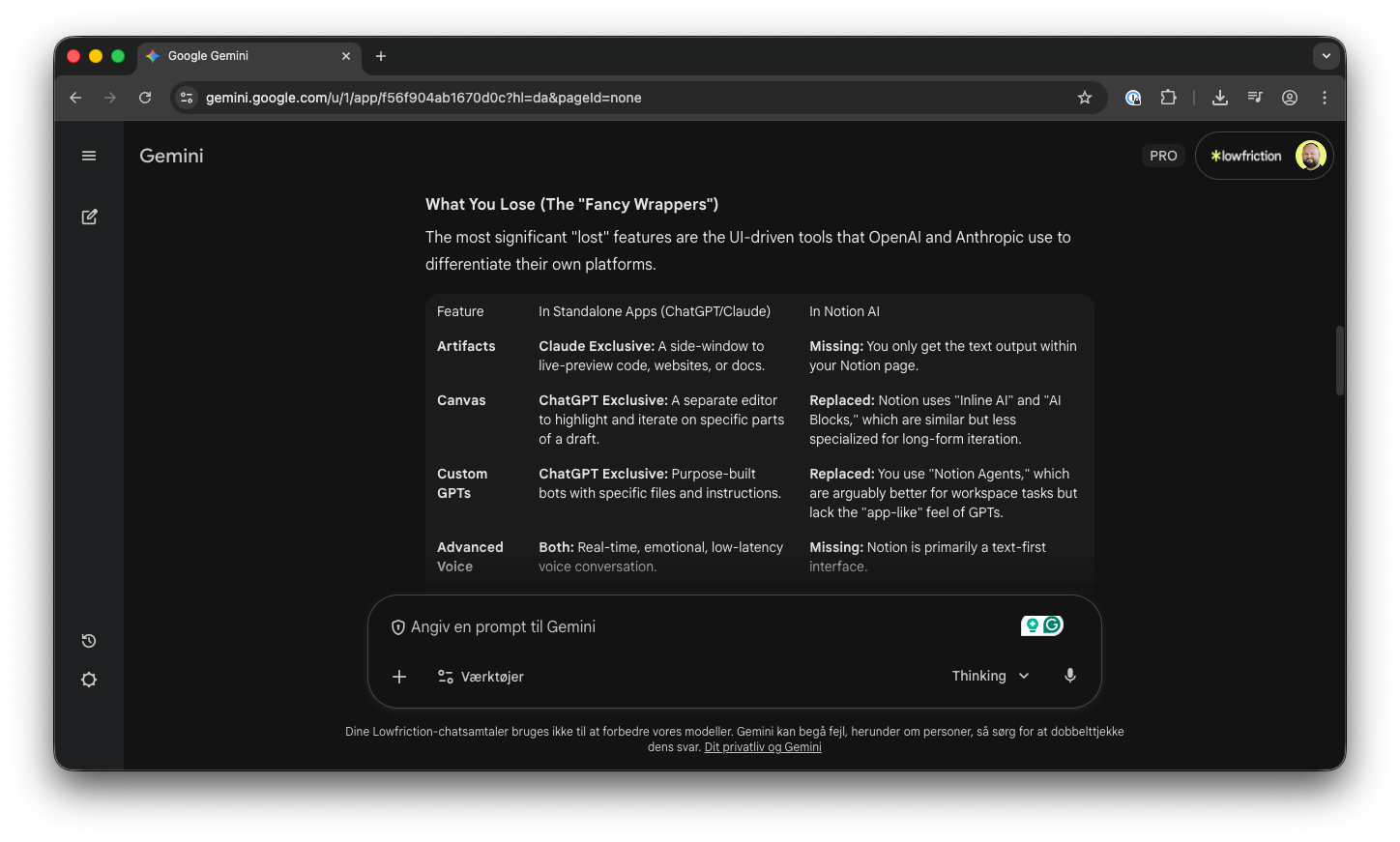
Can you imagine the time-sucking, soul-crushing agony to find this answer on my own?
Tab-Hoarding Googles, Notion Docs, blogs and AI documentation?
Nah…
I asked AI instead.
And I know I’m not the only one doing this.
AI is showing up everywhere in the B2B buying journey now.
Google has the AI overview.
ChatGPT and Gemini is used to compare options.
Perplexity to dig deeper than Google ever allowed.
So I started wondering: How much impact does AI actually have on the buyer journey heading into 2026?
I went looking for data.
And now I’m sharing that data along side my own thoughts with you.
The numbers are real
Let’s start with how buyers feel about AI in their buying process.
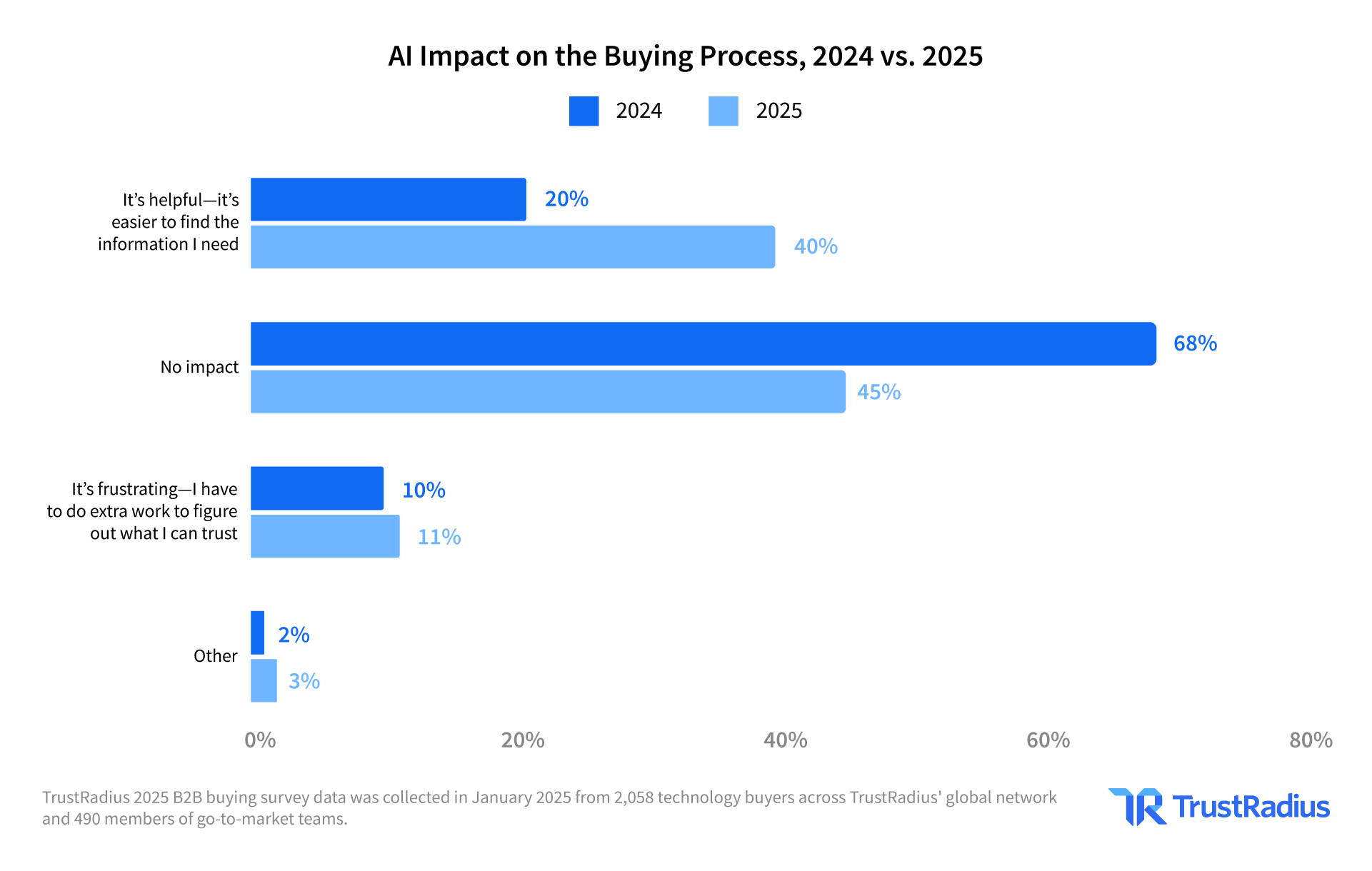
In 2024, most buyers said AI had “no impact.” That’s already changed. Now, over 40% say AI is actively helpful when researching software and the “no impact” group is shrinking fast.
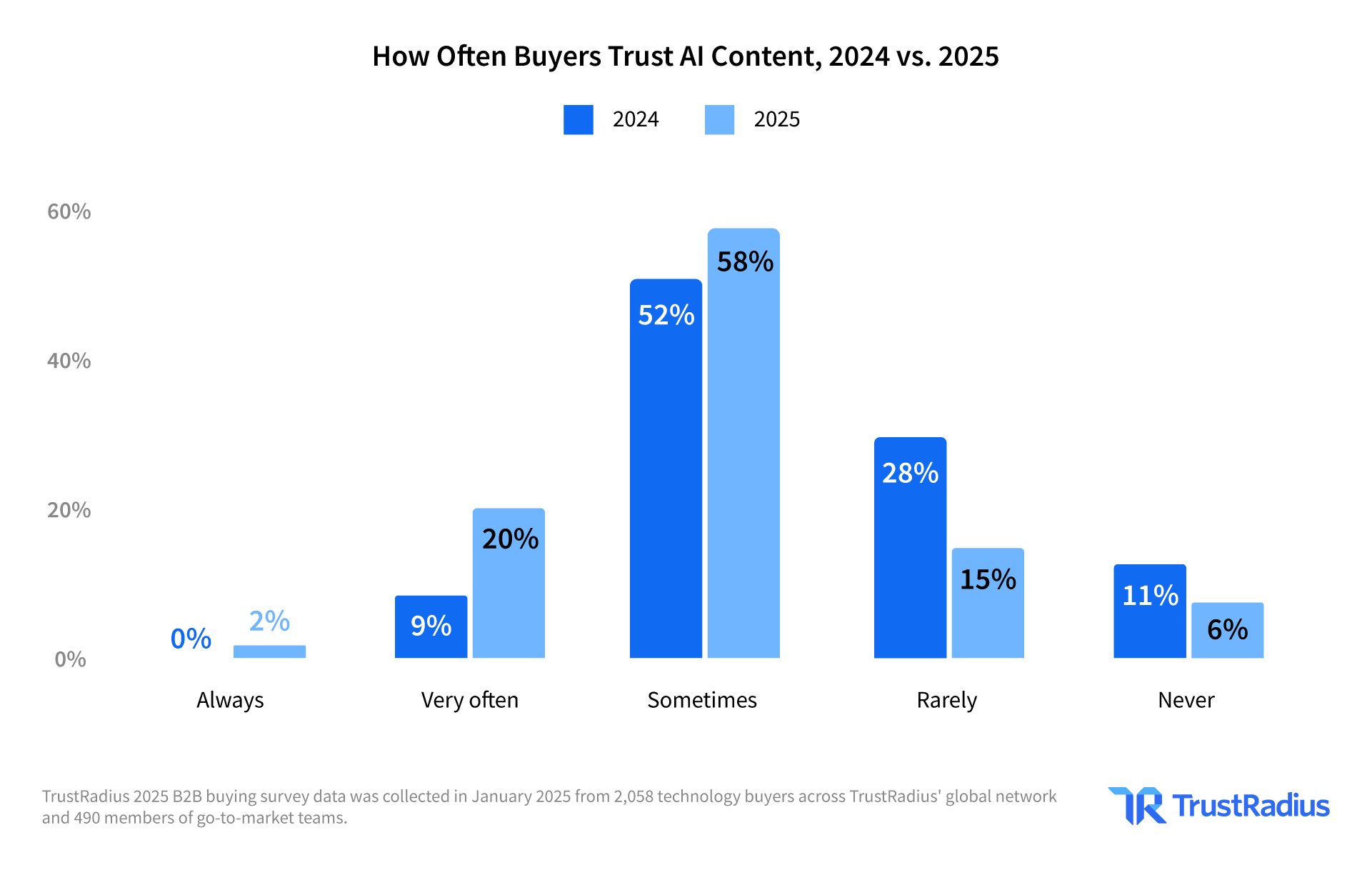
And buyers are trusting AI-generated content more than before. Most say they trust it “Sometimes”, but the highest jump is in “Very often”.
Though I’ll admit: the 2% who say they always trust AI content? Yikes!
Here’s what else stood out from the report:
72% encounter AI Overviews in the discovery phase
90% click sources to learn more (source)
38% start with GenAI chatbots (source)
That last one is huge.
Because it changes how buyers search and view results.
And how you get eyeballs on your content.
If you wanna see the research, head over to TrustRadius (thanks Katie Allison).
So how are they actually using it?
I’ve been eyeing the types of questions people ask AI during a buying process.
That’s the most interesting part to me.
What are they actually trying to learn?
And the biggest find is people are just like me.
Getting deeper, adding more context.
Here are the top 5 ways buyers are ghost shopping for your software with AI.
1. In the old Google Search
AI snippets now appear at the top for queries like:
“Best project management tools for marketing”
“HubSpot alternatives”
Most buyers are still here. On Google. Asking questions.
But with Googles new AI mode, the AI guesses what the searcher is looking for and often gives great depth to simple searches.
And 90% clicks on at least one source from the AI overview in a buying journey.
2. When doing discovery
When buyers go straight to ChatGPT, Gemini or Perplexity, the questions get longer:
“Give me a shortlist of 5 CRM tools for a 20-person B2B sales team selling to mid-market.”
“We are looking at Salesforce and HubSpot — what else should we evaluate as the core for our revenue tech-stack?”
They’re not looking for a list. They’re looking for a fit.
And here is an important learning from my own AI search. They are starting to get complex. With lots of context to your own situation.
This is where AI excels as an experience for the user.
3. For technical specs
Some searches are becoming very technical and feature-rich. Buyers want to know if it works in a specific context:
“Does Tool X support SSO with Azure AD and SCIM? Summarize from the docs.”
“I need to find an employee experience survey tool that works in our Slack space and have API for pulling data”
If your documentation is solid, AI finds it and summarizes it.
If your users have been kind enough to write about it somewhere online, AI finds it and summarizes it.
If not, you simply don’t exist in that conversation.
For B2B SaaS especially, this means that your doc-site really needs to be updated. With features, capabilities, use cases and methodology.
The more context you can provide the LLMs, the more they will surface your product.
4. Price discovery
Because transparent pricing still isn’t table stakes in SaaS (why I still can’t tell you), buyers are reconstructing it themselves:
“Based on public info, estimate the price of [Tool] for 120 users with premium support.”
“Compare the pricing of Tool A and Tool B for 50 seats.”
They know it might not be accurate. But it gives them a ballpark — and the language to challenge vendors with.
** deep breath **
If you don’t have transparent pricing, AI is using forums like Reddit and blog posts to summarize the answers. Things that are totally out of your control and most likely, heavily outdated.
And AI is ruthless.
It’s gonna give the buyer an answer, no matter how wrong it is.
It runs of best possible answer it can find.
So your buyer is making a 2026 decision based on a random 2021 Reddit thread.
Nowhere near your pricing today.
Maybe not even in the same pricing structure.
Not having transparent pricing in 2026 is more offbeat than a jazz band at a square dance.
I’m willing to die on this hill, so expect me to mention this a lot in this newsletter.
** and exhale **
5. Vendor Comparison
This is where I think the shortlist gets created before vendors even know they’re in the race:
“Summarize pros and cons of Tool A vs Tool B for a support team of 40 agents.”
“I need to justify Tool X to our CFO. Give me a bullet list of risks, benefits, and ROI arguments.”
AI is helping buyers build the internal business case. Without sales ever being in the room.
You'd better have those covered so it gets it directly from the right source.
AI buying 5 ways. If you are using it outside this window, let me know. Just reply to this email. I wanna learn more.
Marketers don’t understand how AI finds their content
This stat was really surprising to me.
44% of vendors believe their gated content is being used to answer buyer questions in AI.
It’s not.
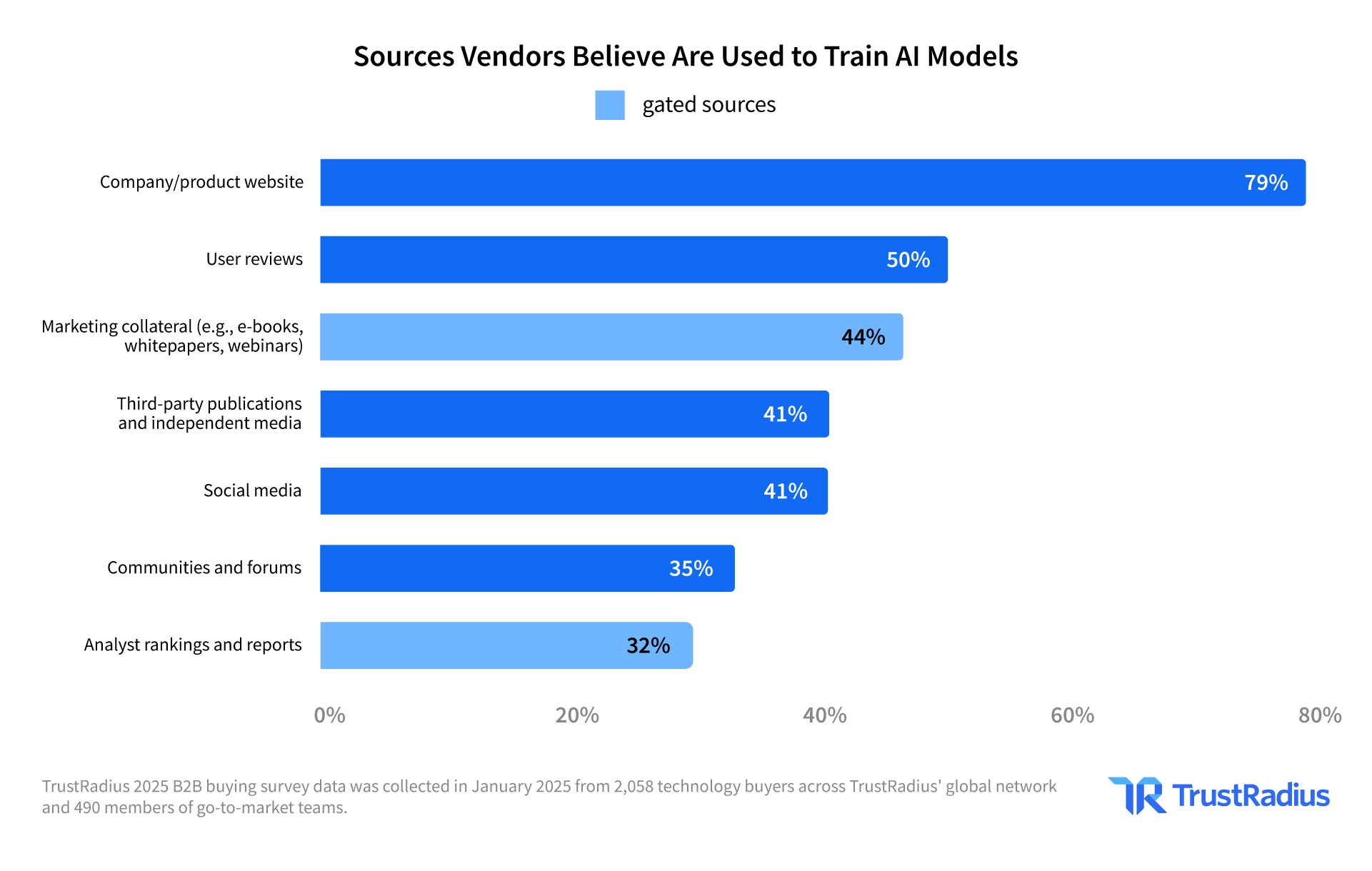
Your buyer guides. Your pricing pages. Your whitepapers. Your ROI calculators. Your market reports.
If it’s behind a form, it doesn’t exist to AI.
Full stop.
So you don’t get surfaced when people ask AI buyer questions where you are relevant.
It’s 2026 folks.
Enough with the gates already.
Speaking of 2026 — where to place your budget?
If you should switch some budget to get surfaced more by the LLMs, here are 7 places you should invest more money in 2026.
Review sites — great source to get cited and awesome for buyers to learn from
Communities — AI (and buyers) love real humans talking about real problems
Deeper feature pages — so AI can answer technical questions about your product
Use case pages — specific “how [Tool] works for [situation]” content
Doc site — gives context to specific technical situations
Customer stories — creates great trustworthiness you can build on
A pricing page — because it’s 2026 and you are missing out without it
I’m so happy to give this advice, because there is a direct correlation between what the LLMs like and what buyers like. To me, this is shifting more budget towards making it easier to buy from you, not getting found by LLM. That’s just the upside.
And this is not a guide on “how to get cited by LLMs”, so don’t take it like it. I just wanted to uncover what is happening with AI and the buyer journey.
Buying with AI is just better
Using AI to research your problem and solution is a superior experience to browsing websites and doing Google searches, as a starting point.
As I went through a lot of research on this topic, I forced myself to think about my own way of using AI.
The depth of answers in the context you decide is something that has changed how I learn about things.
For good.
And I’m not alone.
We don’t make decisions with AI. Yet.
But more and more absolutely start there.
And it forces us to think differently about how we surface answers to buyers of our products.