

Roughly a year ago I started to see ChatGPT show up as the source when we asked people how they found us.
Back when I was CMO.
I shared that on LinkedIn and the sentiment was excitement and… anxiety.
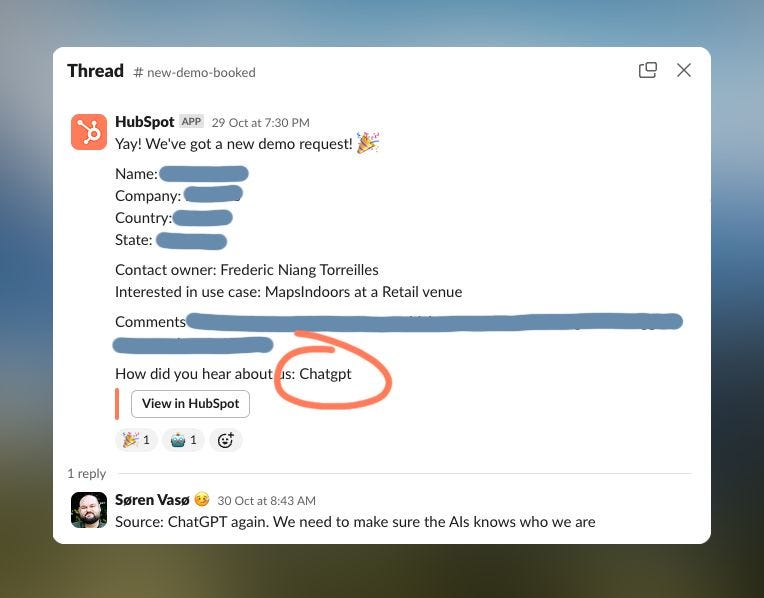
Fast forward to today.
Now it’s ALL anxiety.
Peep Laja from Wynter (do yourself a favor and follow him) did market research among CMOs.
Here are the findings:
“We focus on GEO but don’t have a good benchmark if we’re doing everything that’s doable.”
“AI is taking over search... it’s the most important visibility tool now.”
“The decline in organic search due to zero-click AI search directly impacts our pipeline.”
Everyone is scrambling and there is no proven playbook.
46% of these leaders are actively pulling back from paid ads. They know organic search is declining. And they’re terrified of disappearing from AI answers.
Full on anxiety.
I realized something really obvious when I started to dive into AEO.
And I’ll share that with you in here, so you hopefully can direct your anxiety towards something else instead.
Here it is:
AEO is looking for the same answers as your buyers.
So if you already are working on content to make your buyers pick you, you are probably in a good place when it comes to AEO strategy.
And i’ll prove it to you.

The shift in how buyers search
AI search is fundamentally different. Users ask deeper, more specific, buying-contextual questions.
An example from my own Gemini account just last week:
“I need a simple CRM system for my solo business.
I’ve worked with HubSpot before and like the simplicity of it.
Demands:
Pipeline I can edit as I choose
Can integrate PMs from LinkedIn
Have companies and user levels connected
Is cheap for a single-person startup (free even better until x level)
I’m fairly technical and like a clean nice UI.
My other stack is Notion and G-suite primarily.
Use case is tracking who I talk to and manage my LinkedIn inbox in close relation to my pipeline.”
That is not a Google search.
It’s very contextual to my situation, my needs and personality.
Specific features, pricing, UI and use case.
I’m asking as a buyer, not a searcher.
I don’t need a “Top 10 list of CRMs for small business”.
I want answers in my context.
What AI Actually Looks For
I went on a mission to understand this, so I have a bunch of resources for you if you wanna dive deeper into it. Just follow the links.
It left me with these 5 bullets I had AI help me turn all my findings into:
AI favors content that:
1. Represents an idea clearly
AI systems reward clarity over keyword density. The key is making your content “extractable.” Easy for AI to lift your insights and cite them properly. When someone searches a specific question, your page should load with a crystal-clear answer that’s easy to skim. Direct questions with clear answers mirror the way people search, and AI assistants can often lift these pairs word-for-word into their responses. (Directive Consulting, Microsoft Advertising)
2. Can be summarized safely
AI models prefer high information density with specific facts, statistics, and frameworks they can extract and attribute. Vague statements like “many companies see improved results” get skipped. Quotable statements like “companies using real-time analytics dashboards reduce decision-making time by 35%” give AI something concrete to cite. Create named frameworks that become associated with your brand. “The 4-Phase Implementation Model” is more memorable and citable than generic advice. (Evertune)
3. Aligns with established understanding
AI citation selection works through pattern recognition across vast text collections. Models measure trust through repetition and context. The more your content appears in credible environments saying consistent things, the stronger your statistical trust signal becomes. AI citations are distributed across a long tail of sources, not concentrated among traditional Google top-rankers. Content structure and semantic relevance matter more than traditional ranking position. (Profound, Duane Forrester)
4. Fits a coherent body of knowledge
AI systems prefer content that exists within a larger, interconnected context, not isolated pages. Models build confidence through corroboration. When your content connects to other pages on your site covering related topics and forms a consistent narrative, AI treats it as more trustworthy and “safe to cite.” One-off pages feel risky. Connected content feels stable. Traditional SEO was built to optimize for ranking signals. Generative engines evaluate content based on meaning, clarity, and credibility. They don’t reward volume. They reward understanding. (a16z)
5. Has credibility signals (E-E-A-T)
Experience, Expertise, Authoritativeness, and Trustworthiness. Google’s framework for content quality now extends to AI citation. Research shows LLMs reward expert quotes, statistics, and cited sources, while keyword stuffing barely registers. Trust is built through transparency, consistency, and honesty. AI can’t “feel” trust, but it can measure it through repetition and context. To strengthen your AI trust markers: use structured data for authors and organizations, build external validation (press mentions, conference appearances), and maintain consistent author identity across platforms. (BrightEdge, CXL, Salt Agency)
Let me summarize that differently.
They favor content that:
Represents an idea clearly. They want to skim, get it, and move on. No fluff, just clear answers to their questions.
Can be summarized safely. Specifics they can extract and repeat. Vague claims get ignored.
Aligns with established understanding. If you contradict the consensus, they need proof. No receipts, no trust.
Fits a coherent body of knowledge. Same story, same language, same proof everywhere. Scattered messaging gets forgotten.
Has credibility signals. Customer stories, ROI, third-party validation. Evidence is how they measure trust.
Now re-read that list.
Was I talking about AI or your buyers?
What makes the buyers short-list your is what makes AI cites you.
8 content areas you should invest in
If you put your investment behind these 8 areas, you will serve both the buyers and the AI. I’ve picked these because they work interchangeably with both.
#1 Clear ICP messaging
Give context to who you’re building for. It helps both buyers and AI to understand who you are for and both will reward you for it.
Have industry pages to narrow audience in. Name your buyers in your materials. Keep a tight ICP in your case studies. Make your use cases examples of companies who use you.
#2 Not-good-fit pages
I love a good bad-fit page. Write clearly who you aren’t for. Eliminate bad-fits by clearly explaining your good-fits. That is probably the most specific instructions you can give AEO about your business.
#3 Deep feature pages
Remember my search: “CRM with LinkedIn capabilities, pipeline edit options and Notion integration”. If you describe your features with deep features pages on your product site or in your documentation that you link to, from your product pages, you win BIG in AEO.
This is where the gold is. You give clear instruction to highlight you in front of everyone else because you are telling AI that we most definitely can do what the buyer is asking.
#4 Use case pages
Use case pages pin-point problem/solution matching. So when I searched for “Use case is tracking who I talk to and manage my LinkedIn inbox in close relation to my pipeline” it can match with a “Content Creator CRM” use case page. That tells the AEO everything it needs. And buyers gain confidence to short-list you.
#5 Pricing page
Pricing is a clear-cut disqualifying mechanism. If the buyer is searching within budget ranges and you don’t have pricing, there is a good chance it won’t cite you. Because it doesn’t want to give bad answers. That’s its nature. It will cite anyone else that gives a clear answer that matches the search.
#6 G2, Capterra, TrustRadius reviews
Review sites are used to validate claims. Both from buyers and AI. The AI also has another angle you should learn from. The real customer language on reviews actually trains the AI on how to describe you. Not your website. Your customers voices.
#7 Customer case studies and ROI proof
“What results do customers get?” is a buyer question and an AI training input. Third-party validation and credibility signals are what calms everyone down. Buyers even say it’s some of the most valuable content you can give them.
#8 Community mentions (Reddit, LinkedIn, etc.)
AI looks for signals across the platforms where users talk about your product. So do buyers. And the more raves there are about your product, the more it will impact how they think of you.
It’s not been more than 6 weeks ago I wrote on this topic with my newsletter “AI can’t read your best content (and it hurts your revenue)”. You should read that one too.
Everything changed. Nothing is new.
I remember all the times SEO has been killed.
Or when social media marked our websites R.I.P.
Now it’s AEO’s turn.

And when everything is changing, it comforts me to know that nothing is new.
Operate with your buyer in mind and you will pass the trial of time.
SEO guidelines works towards rewarding those who helped the searchers most.
Social media algorithms reward those who are consistent in messaging and targeting.
AEO will cite you if you are specific in what you do for who and can prove it.
Buying > Selling is a principle I tried to apply to all my work for a decade (at least).
And once again I’ve been confirmed in the direction works no matter how technology change.
That cured my AEO anxiety.
I hope it helps with yours too.
How to be sure
If you really wanna know how you do and discover all the gap, I created this Buyer Friction Grader.
An AI that scans your website and:
→ Grades you on 22 buyer questions
→ Scores you across 9 friction categories
→ Benchmarks you vs. SaaS peers
You’ll know exactly where you stand vs. the market and what to improve.
Takes 60 seconds to get your score.
Looking for 10 SaaS companies to field-test with.
Interested, reply to soren@lowfriction.io
If this helped you, forward it to a friend who it could help as well.
Sharing is caring.